

Conference on
MANUFACTURING AND SUPPLY CHAIN SUMMIT
Winning the Autonomous Supply Chain Era
17th July 2026 Hotel Aurika, Mumbai
Manufacturing supply chains are undergoing structural transformation. What were once optimized primarily for cost efficiency and scale are now being redesigned for resilience, trade agility, digital intelligence, sustainability compliance, and geopolitical adaptability. Over the past few years, persistent disruptions—geopolitical fragmentation, tariff volatility, supply concentration risks, logistics bottlenecks, commodity fluctuations, climate events, and regulatory complexity—have fundamentally altered supply chain priorities. The shift from “just-in-time” to “just-in-case” to “just-in-control” is redefining how manufacturing leaders think about network design, sourcing strategy, inventory buffers, supplier ecosystems, and digital investments. As India advances its ambition to become a global manufacturing and export hub—supported by Production Linked Incentive (PLI) schemes, infrastructure expansion, and trade corridor development—supply chains have emerged as a decisive lever of competitiveness. They influence cost structures, market responsiveness, working capital intensity, sustainability footprint, and export readiness. Simultaneously, digital acceleration—including advanced analytics, AI-driven planning, generative AI for scenario modelling, and emerging agentic systems—is reshaping how decisions are made across planning, procurement, production, and logistics. However, the true differentiator is not technology adoption alone, but the ability to embed faster decision velocity, governance clarity, and cross-functional alignment into operating models.
The Conference will focus on

Integrated operating models that connect planning to execution
Decision-centric digital architectures and AI-led augmentation
Trade-ready network design amid global fragmentation
Supply chain resilience without structural cost inflation
Sustainability and Scope 3 integration into manufacturing supply chains
SESSION 1

DECISION VELOCITY IN LEAN SUPPLY CHAINS: REDEFINING OPERATIONAL EXCELLENCE FOR MANUFACTURING
Lean principles remain fundamental to manufacturing competitiveness. However, lean systems optimized for stability are increasingly tested by volatility—demand swings, supplier concentration, logistics delays, and input cost shocks. In this environment, decision velocity—the ability to sense disruption, evaluate alternatives, and execute corrective actions rapidly—has emerged as a new benchmark of operational excellence. This session will explore how manufacturers are evolving lean systems to become adaptive, without structurally increasing cost.
- When does lean become fragile -and how can adaptive buffers be designed intelligently?
- Planning–execution feedback loops and real-time escalation mechanisms
- Governance and decision rights during supply disruptions
- Inventory strategy shifts: from minimization to optimization
- The evolving role of logistics and supplier partners in accelerating execution
SESSION 2

FROM DIGITAL VISIBILITY TO AUTONOMOUS DECISIONS: THE NEXT GENERATION MANUFACTURING SUPPLY CHAIN
Over the past decade, manufacturing supply chains have invested heavily in visibility tools, ERP modernization, and control towers. However, visibility alone does not guarantee improved performance. The next stage of evolution lies in decision-centric digital architectures—where advanced analytics, AI, and generative scenario modelling enable proactive risk mitigation, demand sensing, dynamic planning, and supply rebalancing. The discussion will focus on execution maturity—not theoretical ambition—highlighting real-world adoption pathways for Indian manufacturing.
- Moving beyond dashboards toward prescriptive and scenario-based planning
- Practical applications of AI and GenAI in forecasting, production planning, and risk modelling
- Integrating digital twins and network simulations into supply chain design
- Governance frameworks: balancing automation, accountability, and human oversight
- Translating digital investments into measurable cost, service, and resilience outcomes
SESSION 3

COMPETING IN A CONSTRAINED GLOBAL MARKET: MANAGING TARIFFS, TRADE BARRIERS AND EXIM STRATEGY
Global trade architecture is being reshaped by tariff shifts, regional trade blocs, export controls, sanctions, non-tariff barriers, and evolving compliance regimes. For manufacturing organizations, trade readiness is now a board-level issue. Supply chains must be designed to anticipate and absorb trade shocks without undermining cost competitiveness or service reliability.
- Diversified sourcing strategies and alternate market access
- Network redesign aligned to regional trade agreements
- Managing tariff volatility and customs complexity
- Strengthening documentation, compliance, and regulatory preparedness
- Leveraging logistics partnerships to enhance trade execution capability
The discussion will examine how trade complexity can be converted into competitive advantage by identifying emerging export corridors and strategic partnerships.
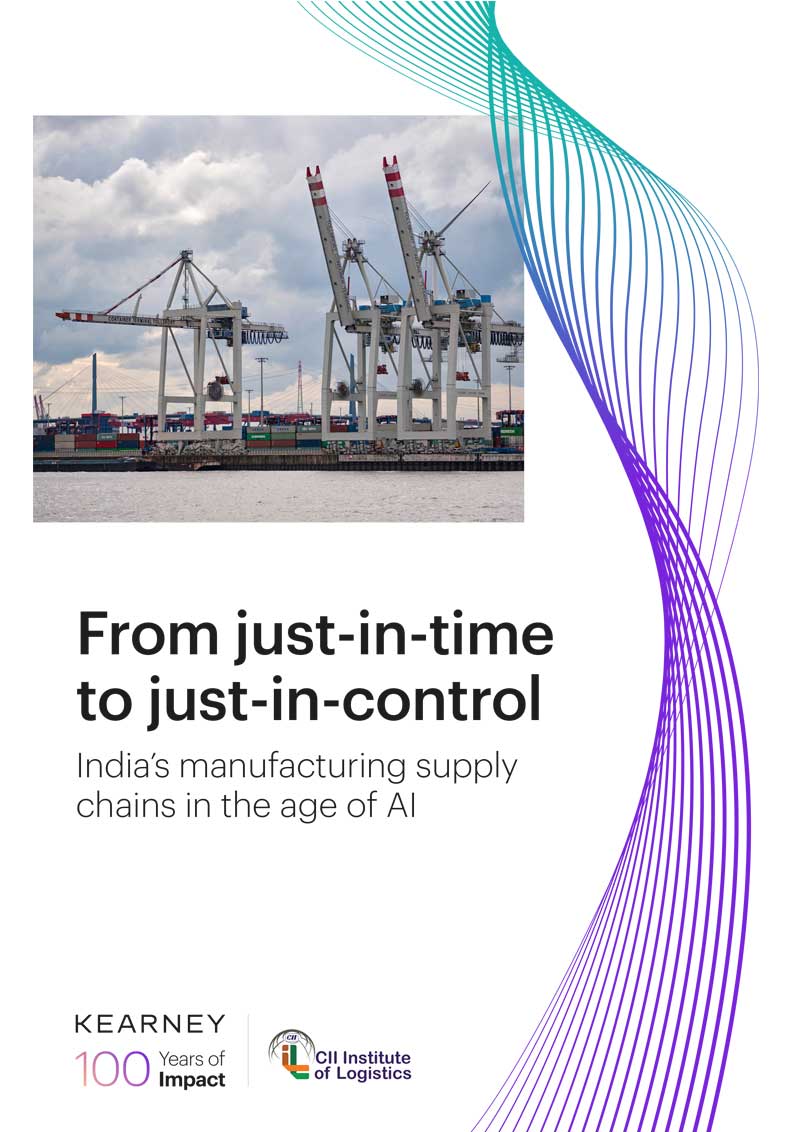
For global sourcing, low cost might open the door, but reliability and resilience are what keeps it open. India’s manufacturing ambition has rarely had more behind it: sustained policy support, rising investment, and a global appetite to diversify sourcing away from single-country dependence. Yet ambition and momentum are not the same as competitiveness. The countries and companies that win the next decade of global sourcing will be those with supply chains that perform reliably when conditions are difficult, not simply those that can produce at the lowest cost. For India, the decisive question is no longer whether manufacturing can scale, but whether the supply chains around that base are ready to compete. In this article, developed in collaboration with the CII Institute of Logistics, we make the case for a deliberate change of posture from just-in-time efficiency to just-in-control: supply chains that stay lean where it pays to be but are also fast, governed,and resilient by design.
DownloadContact
Register
+91-98791 60202 +91-72003 79132 sreeramkumar.j@cii.in conference.cii@cii.in
Register Online

Sponsor Enquiry
+91-72003 79132 +91-98791 60202 sreeramkumar.j@cii.in smitha.nair@cii.in